Showing posts with label white wine. Show all posts

Monday, August 1, 2011

Slow-Cooker Pot Roast


Lunch - 01 August 2011, originally uploaded by essgee51.
We've mostly been repeating recipes, so I haven't been posting variations. This weekend, we once again turned to the trusty Slow Cooker Revolution, halving some parts of the recipe and using a blade roast instead of the asked-for boneless pork picnic shoulder roast (see below).


Turned out really well - richer and meatier for the inclusion of the bone. This one will definitely become a regular.
  • 1 T vegetable oil
  • 1 onion, minced
  • 3 garlic cloves, minced
  • 1 T tomato paste
  • 2 t fresh thyme, minced
  • 1/8 c all-purpose flour
  • 1/4 c white wine
  • 14.5 oz. can diced tomatoes, drained
  • 1 lb. carrots, peeled and cut into 1 in. chunks
  • 1 lb. parsnips, peeled and cut into 1 in. chunks
  • 1 blade roast, trimmed
  • salt and pepper
  • 1 t white wine vinegar
Put oil in a skillet over medium-high heat until shimmering. Add onions, garlic, tomato paste, and thyme. Cook till onions are softened and browning, 8-10 minutes. Stir in flour and cook for 1 minute. Whisk in wine, scraping up any browned bits, till smooth. Transfer mixture to slow cooker.

Put tomatoes, carrots and parsnips into slow cooker. Season roast with salt and pepper; add to slow cooker. Cover and cook till pork is tender (five hours on high worked fine for me; the book recommends 9-11 hours on low or 5-7 on high).

Transfer roast to cutting board, tent with aluminum foil and rest for 20 minutes.

Let braising liquid settle, then remove fat, if you like (we skipped this). Stir in vinegar and season with salt and pepper to taste.

Slice roast, spoon sauce over the slices, and serve.

Monday, May 9, 2011

Navy Bean Stew with Chicken and Sausage


From our trusty copy of Slow Cooker Revolution. I used dried beans instead of canned and made a couple of other tweaks. Though I was worried about the adjustments to liquid level and cooking time, the tweaks worked out fairly well; in the interests of boosting flavor, I increase the stock-to-water ratio or decrease the liquid altogether, as well as adjust the levels of  spices and aromatics. The recipe itself is a bit fussy, but as far as I can tell, all steps are worth it.
  • 2 lbs. boneless, skinless chicken thighs
  • salt and pepper
  • 3 T vegetable oil
  • 1 lb. Italian sausages, sliced 1 in. thick
  • 2 onions, minced
  • 1 fennel bulb, tops discarded; bulb halved, cored and sliced thin
  • 6 plump garlic cloves, minced (about 3 T)
  • 1 T tomato paste
  • 1 T fresh thyme, minced (halve for dried)
  • 1/8 t red pepper flakes (may increase this in the future)
  • 1/3 c all-purpose flour
  • 1/2 cup dry white wine
  • 4 c chicken stock
  • 3 c hot water
  • 2 bay leaves
  • 1 lb. dried navy beans 
  • 6 oz. baby spinach
  • grated Parmesan cheese, for serving
Dry chicken with paper towels and season with salt and pepper. Heat 1 tablespoon of the oil in a large skillet over medium-high heat. Brown half the chicken lightly on both sides, working in batches if necessary (5-8 min.), then transfer to a bowl. Add 1 more tablespoon of oil and repeat with the rest of the chicken; move to bowl.

Add the last tablespoon of oil to the skillet. Brown the sausage well (3-5 min.); transfer to a bowl with the chicken.

Pour off all but 1-2 tablespoons of oil. Add onions, fennel, garlic, tomato paste, thyme and red pepper flakes. Cook over medium-high heat till vegetables are soft and lightly browned (8-12 min.).

Stir in flour and cook for 1-2 minutes. Whisk in wine; scrape up any browned bits and smooth out any lumps (whisk in a cup of the broth if necessary). Transfer the vegetables and liquid to the slow cooker.

Stir the remaining liquid and bay leaves into the slow cooker. Add the beans (skipped the initial soaking, but they seemed fine) and the meat (as well as any accumulated juices) to the slow cooker as well.

Cover and cook till beans are done and chicken is tender. I had success with 3 hours on low and 2 hours on high.

Let stew settle, then remove fat from surface using large spoon (skipped this step). Remove chicken, shred and return to the pot, if you like (I left it whole, as it was falling-apart soft later).

Stir in spinach, cover, and cook on high till heated through, about 10 minutes. Adjust seasoning and serve with grated Parmesan.

Sunday, April 10, 2011

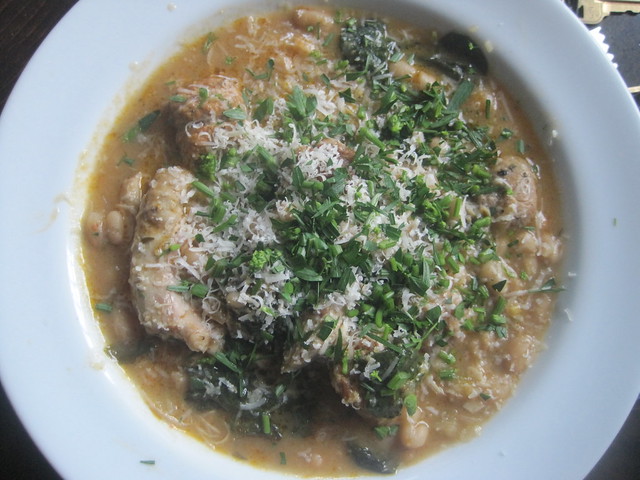
Lengua Estofada


Lengua was always one of my favorite childhood dishes - my lola used to put extra button mushrooms in it for me. Finally I decided to try my own version of it - not a recreation of the beefy richness I remember, but something to tweak and turn into an occasional indulgence. I started from a recipe in Let's Cook with Nora, and made several changes - most notably trebling the amount of mushrooms (what? I love them). It turned out wonderfully - the meat was tender, the sauce (more of a broth by thickness) rich and tangy but sweet from the carrots and leeks. I may try a more umami-laden version in the future, but this recipe is a keeper.

Since this is the first time I've ever tried this (and since I had an epic, 20-minute battle with the leathery outer coating of the tongue), I've felt obliged to document (and share said documentation of) the process.
  • 1 beef tongue (2.6 lbs. or so)
  • 1/4 cup vinegar
  • 1-2 T salt
  • 1/2 cup olive oil
  • 2 medium onions, quartered
  • 1 head garlic, cloves peeled and crushed
  • 1 t peppercorns
  • 1 bay leaf
  • 1 clove
  • 2 carrots, cut into rough chunks
  • 3 leeks, cleaned and sliced
  • 1 28 oz. can whole tomatoes, including juice
  • 1/2 cup white wine
  • 1 to 1-1/2 cup water
  • 3-4 cups mushrooms, cleaned and trimmed (used a mix of white and cremini)
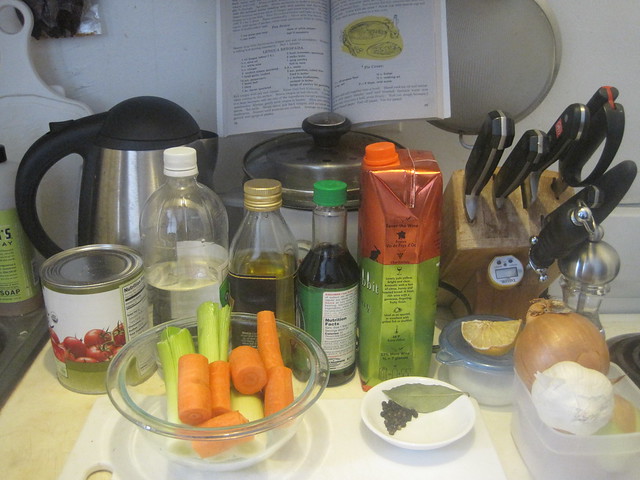
Here are most of the assembled ingredients.


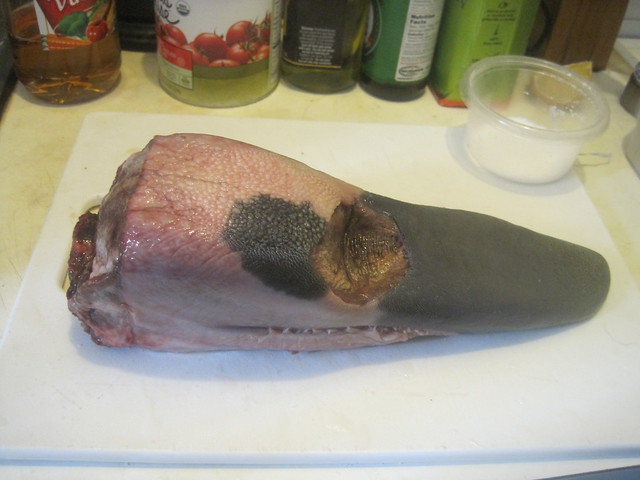
Rub tongue with salt and vinegar (pre-boiled tongue below - doesn't look very different after this step). Rinse, then boil for 10 minutes.


Scrape off leathery coating on surface. (Mind, this took me 20 minutes with three different knives. It got pretty gnarly in the end, but I triumphed. It probably would have been much easier if I'd boiled the tongue for the whole time first, but I wanted it to braise with the sauce.)

Brown tongue in oil (5-10 minutes.)

Transfer to plate, then brown the onions and the garlic.


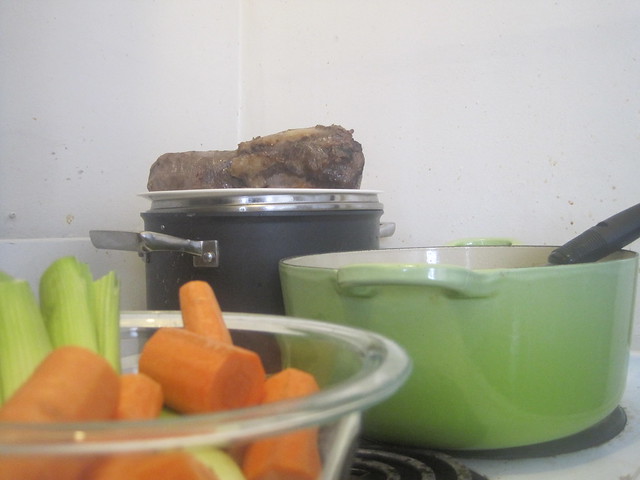
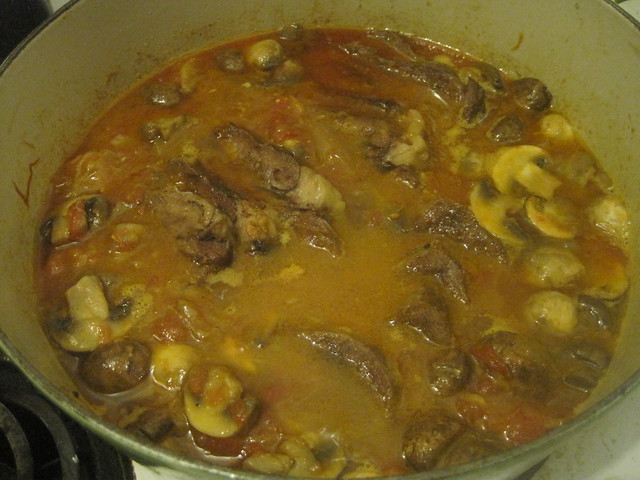
Return tongue to pot, then add everything but the mushrooms. (I may try adding less water next time.) Bring to a boil then simmer gently till the tongue is tender (recipes say three hours, it took me more like four).

Slice tongue into pieces and set aside (when I gave John a taste at this point, he said it was just like brisket or pot roast).


Strain sauce (skipped this step). Add mushrooms; turn heat to medium or high and cook for a few minutes, till sauce is reduced and mushrooms are done. Return tongue to pot and warm through. 


Serve with rice and garnish with parsley. Enjoy!

Wednesday, September 15, 2010

Pasta with Sausage, Cream and Cheese


I was ready to have leftover  split pea soup (made with ham hocks, naturally) for dinner before I came across this recipe. John kindly bought ingredients, and we had a rich, flavorful dinner. Next time: more blue cheese (we could hardly taste it, even after tripling the amount in the recipe). This would also be a good one-pot meal with a bunch of spinach or other leafy greens added. Tweaked version below.
  • 8 oz. pasta
  • 2 tbsp. olive oil
  • 8 oz. sweet Italian sausage, cut into 1 in. lengths (6 oz. in original)
  • 1/2 cup white wine
  • 1/4 cup loosely packed basil, chopped (oregano in the original)
  • 1-1/2 oz. blue cheese (1/2 oz in the original)
  • 1/4 cup half and half (cream in the original)
  • salt and pepper to taste
  • 1/4 cup Parmigiano-Reggiano, grated, for garnish  (a treat, as we didn't have Parmesan handy)
Bring lots of salted water to a boil and cook pasta till done. Reserve a half cup or so of pasta water.

Meanwhile, heat oil in a large skillet over medium-high heat. Add sausage and brown, about 5-10 minutes.

Add wine, turn to high, and reduce for about 2 minutes. Add herbs, blue cheese and cream, cooking till the cheese is melted and the liquid has begun to thicken.

Mix with the pasta, adding pasta water or additional cheese till a nice, saucy consistency has been reached. Serve, passing around Parmigiano-Reggiano/Parmesan to garnish.

Wednesday, April 1, 2009

Poached Catfish with Ginger and Soy Sauce

This is one of my go-to recipes for catfish (which, as the tag cloud informs me, I eat more of than I thought): simple, quick and delicious. I can't recall if it's in the revised Bittman, but it's certainly in the first. Original recipe below, with my changes in italics:
  • 2 tbsp. peanut oil
  • 2-4 cloves garlic, minced (original: 1)
  • 5 tbsp. minced or grated ginger
  • 1/2 cup water (broth works, too)
  • 1/4 cup slightly diluted dry vermouth (didn't have any white wine, as per the original)
  • 1/4 cup soy sauce
  • salt and freshly-ground pepper to taste
  • 1 to 1-1/2 lbs. catfish fillets
  • 2 scallions, chopped, for garnish
In a large skillet, heat the oil on medium. Add the garlic and ginger and saute till the garlic begins to color. (NOTE: Bittman reserves 1 tbsp. of ginger for garnish at the end. I didn't.)

Add the liquid and turn the heat to high. Boil till the liquid's been reduced by about half - this should only take a couple of minutes. Season to taste.

Turn the heat back to medium and add the catfish. Cover and cook till fillets are no longer translucent - about 5 minutes.

Remove from heat. Garnish with scallions and serve.

Monday, March 9, 2009

Chicken Garlic Stew

I was going to try a new chicken recipe, but we were all playing MLB 2K9 across the hall (my Yanks got spanked by the Indians, though fortunately Joba Chamberlain was not attacked by insects this time), and I wanted to minimize my at-stove presence. So I made this old standby (from Bittman) instead. It came out quite well (how can one go wrong with oodles of stewed garlic?) - John and I had it over white rice for a late dinner (after the ignominious defeat of our Nats by the Rockies), and some more is sitting under my desk in today's Mr. Bento. My tweaked version of the recipe is below:
  • 2 tbsp. olive oil
  • 1-1/2 lbs. chicken thighs (1/2 of what the original recipe called for, but I like sauce)
  • salt and freshly ground pepper to taste
  • at least 2 heads of garlic, separated into cloves but not peeled (I used 3-1/2 small ones this time))
  • 1/2 tsp. allspice (double what Bittman calls for; I much prefer this to cinammon, which is also a possibility)
  • 1/2 cup chopped parsley (heaping)
  • 1/2 cup dry white wine (other options include stock and water)
Put olive oil in a Dutch oven over medium-high heat. Brown chicken well, turning when necessary. (This should take 10-12 minutes, but my pot was a bit too hot and the skin started sticking, so I peeled it off and abbreviated to about 6 mins.)

Sprinkle chicken pieces with salt and pepper; add allspice, parsley, garlic and liquid to the pot. Bring to a boil. Lower heat till liquid is at a brisk simmer, then cover the pot and play more Xb leave unattended till chicken and garlic are very tender, at least 1 hour.

Uncover. Correct seasoning, and serve (Bittman defaults to bread; I default to white rice).

Thursday, February 19, 2009

Dreaming of Summer - Le Petit Hiboux

I first read about Lillet in Thomas Harris' Hannibal; the title character serves it with a slice of orange after dinner. It does make a nice aperitif - even when you haven't been dining on the brains of your beloved's enemy beforehand. This cocktail (via CHOW), the product of The Little Owl restaurant in Brooklyn, is a simple, easy but lovely drink. It was - and will probably be, once the weather warms up again - one of the staples of our weekend "lawn" lounging.
  • 2 ounces Pinot Blanc or New Zealand Sauvignon Blanc
  • 2 ounces Lillet Blanc
  • 2 ounces apple juice
Pour all ingredients into an ice-filled glass and stir.